

If you're considering Stratocaster blender wiring or a 7-way Strat wiring mod, both options expand the pickup combinations available from a traditional Stratocaster.
The key difference is how those combinations are selected.
A 7-way Strat mod adds the neck pickup to selected positions on the standard 5-way switch, typically providing fixed combinations such as bridge + neck and bridge + middle + neck.
A blender circuit uses an additional control to vary the contribution of one pickup relative to the pickup or pickups selected by the 5-way switch. Depending on the circuit, this provides continuously variable combinations rather than two additional fixed selections.
The Short Version
- 7-way Strat wiring: extra pickup combinations selected by an additional switch.
- Strat blender wiring: variable pickup mixing using a dedicated control.
Neither approach is inherently better. They offer different ways to combine the same three Strat pickups.
Strat Blender Wiring vs 7-Way Wiring: Key Differences
| Feature | Strat Blender Wiring | 7-Way Strat / Gilmour Mod |
|---|---|---|
| Standard 5-way switch | Yes | Yes |
| Adds bridge + neck | Usually, depending on the circuit | Yes |
| Adds all three pickups | Usually, depending on the circuit | Yes |
| Continuous pickup blending | Yes | No |
| Extra switch positions | No | Yes |
| Uses an additional control | Yes – blender pot | Usually push/pull switch |
| Traditional 5-way sounds retained | Usually | Yes |
| Pickup combinations | Variable | Fixed |
| Control layout | Usually master volume + master tone + blender | Volume + two tone controls, with push/pull integrated into one control |
| Particularly useful for | Variable pickup mixing | Simple, repeatable additional combinations |
What Is Stratocaster Blender Wiring?
A Stratocaster blender mod adds a control that varies the contribution of an additional pickup alongside the pickup or pickups selected by the 5-way switch.
In a common arrangement, the 5-way continues to select the usual Strat combinations:
- Bridge
- Bridge + middle
- Middle
- Middle + neck
- Neck
The blender then introduces another pickup according to the circuit design.
For example:
- In bridge, it may add some neck pickup.
- In bridge + middle, it may add some neck pickup, creating a variable three-pickup combination.
- In neck, it may add some bridge pickup.
- In neck + middle, it may add some bridge pickup.
Other circuits use different switching arrangements, so the available combinations should always be confirmed from the specific harness schematic or manufacturer's description.
The blender control does not necessarily represent a literal, calibrated percentage mix. It changes the electrical contribution of the additional pickup, while the audible result depends on pickup output, impedance, loading and the rest of the circuit.
How an ObsidianWire Blender Works
The ObsidianWire Universal Blender for Strat uses a master volume, master tone and dedicated blender control.
With the blender at its inactive setting, the guitar operates like a conventional 5-way Strat. Moving it away from that setting introduces the additional pickup contribution provided by the circuit.
Depending on the selected 5-way position, this can provide variable bridge + neck or all-three-pickup combinations. These are blended sounds rather than separate, fixed switch positions.
Explore the ObsidianWire Universal Blender
What Is 7-Way Strat Wiring?
A 7-way Stratocaster wiring mod, often called the Gilmour mod, retains the normal five positions of the 5-way selector and adds a switch that connects the neck pickup independently.
In the standard Gilmour arrangement, the added switch connects the neck pickup when the 5-way is in positions 1 or 2.
This creates:
- Bridge + neck in position 1
- Bridge + middle + neck in position 2
The normal 5-way sounds remain available when the added switch is off.
Standard 5-Way Strat
- Bridge
- Bridge + middle
- Middle
- Middle + neck
- Neck
7-Way / Gilmour Operation
- Bridge + neck
- Bridge + middle + neck
- Middle
- Middle + neck
- Neck
The added switch does not create five completely new positions. It adds the neck pickup to the bridge and bridge + middle positions, producing two additional combinations.
Why Is It Called the Gilmour Mod?
The 7-way modification is strongly associated with David Gilmour, whose Stratocaster tones helped popularize the bridge + neck combination.
A conventional Stratocaster 5-way switch does not normally provide that combination. The additional switch connects the neck pickup to the bridge-side positions while preserving the standard switching when disengaged.
ObsidianWire's Custom 7 Way Gen 2 follows this Gilmour-style approach and integrates the added switching into a push/pull control.
Explore the ObsidianWire Custom 7 Way Gen 2
Blender vs 7-Way: The Biggest Difference
The distinction is easiest to understand as variable mixing versus fixed selection.
7-Way
The added switch provides defined combinations:
Bridge → Bridge + neck
Bridge + middle → Bridge + middle + neck
The other three 5-way positions remain unchanged in the standard Gilmour arrangement.
Blender
The additional control varies the contribution of another pickup:
Bridge → bridge with some neck → bridge with more neck
Or:
Bridge + middle → bridge + middle with some neck → bridge + middle + neck
The exact behaviour depends on the circuit. A blender is therefore a variable pickup-mixing control, while a 7-way modification adds specific, repeatable combinations.
Stratocaster Tone Control Layouts
Pickup switching and tone-control assignment are separate design choices. Two Strat wiring harnesses may offer similar pickup combinations while giving you very different ways to shape their sound.
This is an important consideration when choosing a Stratocaster wiring harness.
Traditional Stratocaster Tone Controls
A conventional Strat typically has:
- Volume
- Tone 1
- Tone 2
These controls are usually assigned to different pickups or pickup combinations. Common arrangements give one tone control to the neck pickup and another to the middle pickup, while the bridge pickup may not have a dedicated tone control.
As a result, the bridge pickup can sound noticeably brighter than the neck and middle pickups.
ObsidianWire 7-Way Tone Control Layout
ObsidianWire's Custom 7 Way Gen 2 assigns its tone controls as follows:
Tone Control 1
Neck + middle pickups
This operates across positions 2–5.
Tone Control 2
Bridge pickup
This operates in positions 1–2.
The bridge therefore has its own tone control, while the neck and middle pickups share the other.
This can be useful when working with the bright bridge pickup and the additional bridge + neck combinations.
ObsidianWire Blender Tone Control Layout
The ObsidianWire Universal Blender uses a simpler three-control layout:
1. Master Volume
Controls the output of all three pickups.
2. Master Tone
Controls the guitar's overall treble roll-off.
3. Blender
Controls the variable pickup blend provided by the circuit.
Unlike a traditional Strat, it does not use two separate pickup tone controls. Instead, it combines one master tone control with the dedicated blender.
The layout can be thought of as:
- Volume → overall level
- Tone → overall brightness
- Blender → pickup mix
Tone Control Layout Comparison
| Control | Traditional Strat | ObsidianWire Blender | ObsidianWire 7-Way Gen 2 |
|---|---|---|---|
| Volume | Master volume | Master volume | Master volume |
| Tone 1 | Neck / traditional assignment | Master tone | Neck + middle |
| Tone 2 | Middle / traditional assignment | Blender | Bridge |
| Extra switching | No | Blender control | Push/pull 7-way |
| Bridge tone control | Depends on wiring | Master tone | Dedicated bridge tone |
| Overall tone control | No | Yes | No |
| Variable pickup blending | No | Yes | No |
The main takeaway is that the pickup modification and tone-control layout should be evaluated separately.
Which Gives You More Control?
It depends on the type of control you want.
A 7-way circuit gives you more selectable combinations. A blender gives you more control over the balance between pickups, within the limits of its wiring.
With a standard Gilmour-style 7-way setup, you can select:
Bridge + neck
With a blender, you may be able to move through:
Bridge → bridge with some neck → bridge with more neck → bridge + neck
These are illustrative rather than calibrated percentages, and not every blender circuit provides every transition.
Which Sounds Better?
There is no universal answer. Neither modification creates a new pickup; both change how the existing pickups are combined.
The result depends on:
- Pickup output
- Pickup voicing
- Pickup polarity and winding
- Potentiometer values
- Capacitor value
- Tone-control configuration
- Pickup height
- Amplifier settings
- Which pickups the circuit combines
- Blender position, where applicable
The bridge + neck combination can produce a fuller sound with some Telecaster-like qualities. An all-three-pickup combination can also sound broader than the standard Strat options.
Strat Blender Wiring: Advantages
- Variable control: the additional pickup can be introduced gradually rather than selected only as on or off.
- Bridge + neck tones: where supported by the circuit, the blender can provide a variable bridge + neck combination.
- All-three-pickup tones: where the wiring permits it, the blender can introduce the third pickup into a two-pickup combination.
- Familiar 5-way operation: the underlying 5-way configuration can be retained.
- Flexible experimentation: the continuous control makes it easier to find intermediate pickup balances.
7-Way Strat Wiring: Advantages
- Simple additional combinations: the extra sounds are available through the added switch function.
- Easy to repeat: once you select bridge + neck or all three pickups, the same combination is immediately available again.
- Traditional Strat controls: a 7-way harness can retain a familiar two-tone-control layout.
- Minimal visual change: a push/pull implementation can add the extra switching without requiring another hole in the pickguard.
Which Strat Wiring Modification Should You Choose?
The choice depends on how you want to access the additional sounds.
Choose a Strat Blender If You Want:
- Continuous pickup blending
- Variable pickup combinations
- A variable bridge + neck sound, where supported
- All-three-pickup blending, where supported
- A master tone control
- A dedicated pickup-mix control
- A versatile wiring option for SSS, HSS, HSH and HHH configurations where supported
Shop the ObsidianWire Universal Blender
Choose 7-Way Strat Wiring If You Want:
- A standard 5-way Strat plus two additional combinations
- Bridge + neck
- Bridge + middle + neck
- Simple, repeatable switching
- Two dedicated tone controls
- A conventional Strat-style control layout
- A Gilmour-style modification
Shop the ObsidianWire Custom 7 Way Gen 2
Is a Strat Blender the Same as a 7-Way Strat?
No.
Both can provide access to bridge + neck and, in some configurations, all three pickups, but they do so differently.
A 7-way Strat uses an additional switch to connect the neck pickup to the bridge-side positions. In the standard Gilmour arrangement, this produces bridge + neck in position 1 and bridge + middle + neck in position 2.
A Strat blender uses a potentiometer to vary the contribution of an additional pickup. The available combinations depend on the circuit and the selected 5-way position.
Choose 7-way wiring for quick, repeatable access to defined combinations. Choose a blender for continuously adjustable pickup mixing.
ObsidianWire Stratocaster Wiring Options
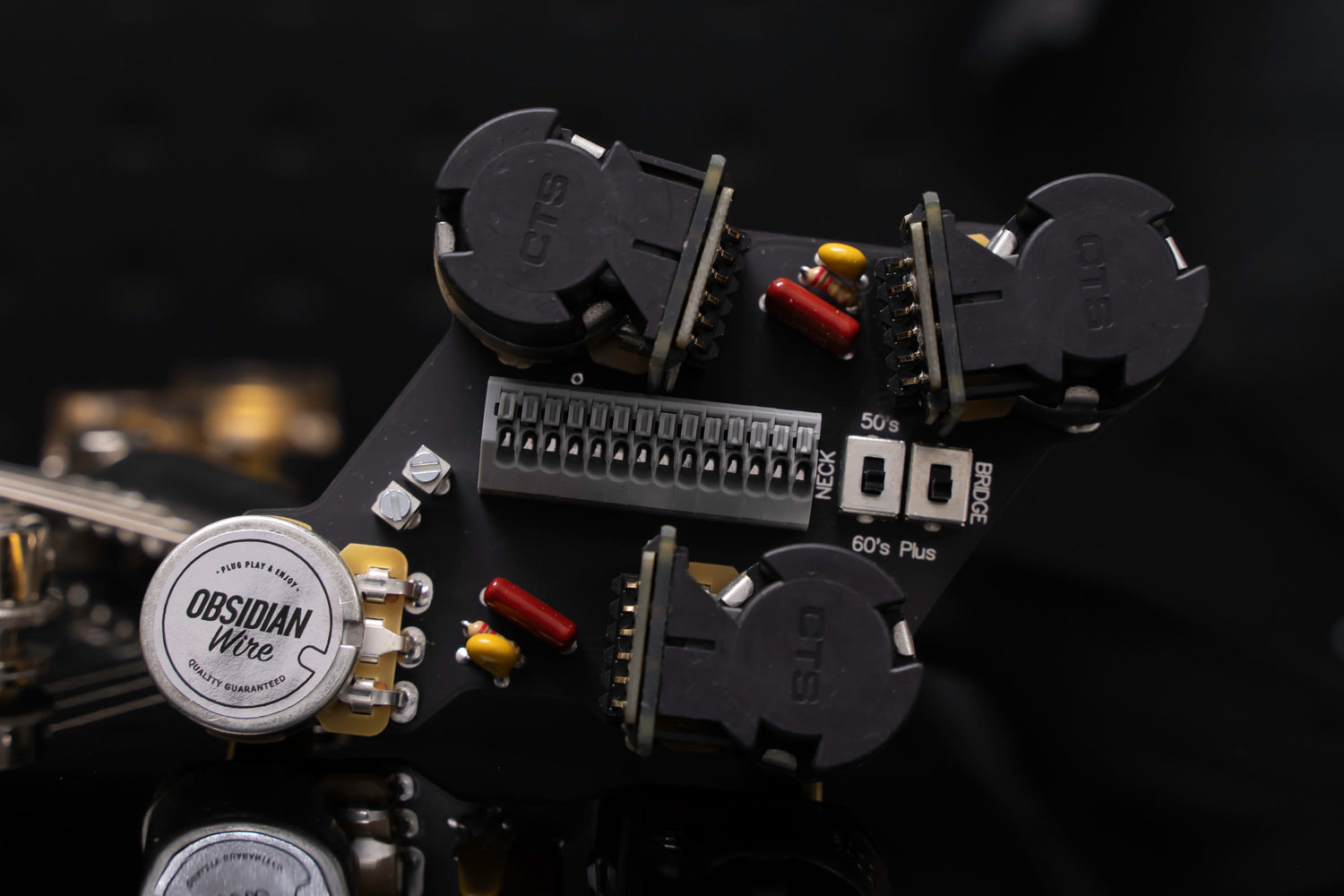
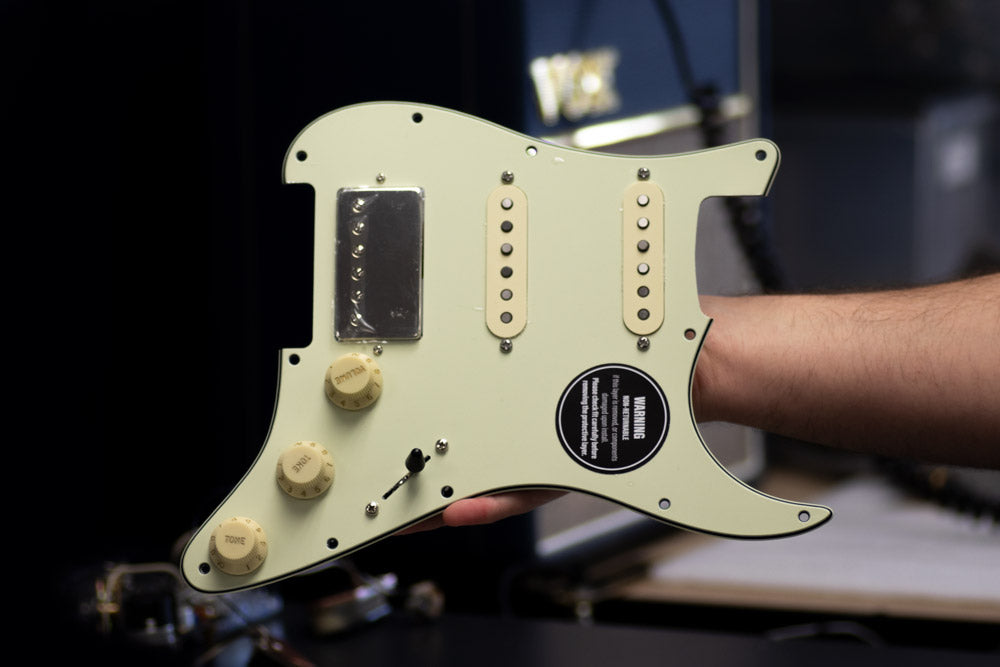
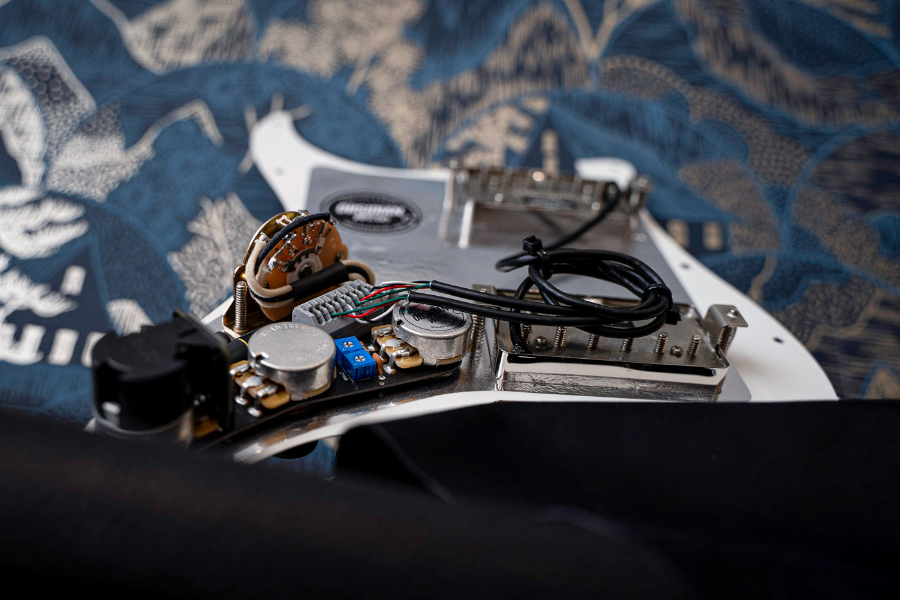
ObsidianWire offers both approaches as professionally assembled, solderless Strat wiring harnesses.
The Universal Blender for Strat is available for SSS, HSS, HSH and HHH configurations and includes master volume, master tone and blender functionality. The exact combinations depend on the selected configuration and wiring.
The Custom 7 Way Gen 2 is designed for SSS Stratocasters and combines Gilmour-style switching with an updated tone-control layout, switchable volume-control voicing and solderless pickup connections.
Both use ObsidianWire's Pro-Wired solderless connector system, allowing compatible pickups to be changed without traditional soldering.
Frequently Asked Questions
What is a blender mod on a Stratocaster?
A Stratocaster blender mod adds a control that varies the contribution of an additional pickup alongside the pickup or pickups selected by the 5-way switch. The exact combinations depend on the circuit.
What does a 7-way switch do on a Strat?
A standard Gilmour-style 7-way modification adds the neck pickup to the bridge and bridge + middle positions. This provides bridge + neck and bridge + middle + neck while retaining the normal five 5-way sounds.
Is the Gilmour mod the same as 7-way Strat wiring?
The terms generally refer to the same type of modification: adding switching that connects the neck pickup to the bridge-side positions of the 5-way selector.
Does a Strat blender give you bridge and neck together?
It can, if the circuit allows the bridge and neck pickups to be combined. It may also provide all three pickups in positions where the third pickup can be introduced.
Does a 7-way Strat have a blender?
No. A conventional 7-way/Gilmour-style modification uses additional switching rather than a continuously variable blender control.
Which has better tone controls: blender or 7-way?
They use different layouts. A blender setup can use a master tone control, while ObsidianWire's Custom 7 Way Gen 2 uses Tone 1 for neck + middle and Tone 2 for bridge.
Can I install a blender or 7-way harness without soldering?
ObsidianWire's Pro-Wired Strat harnesses are designed for solderless installation and use plug-and-play pickup connectors with compatible pickups.
Strat Blender vs 7-Way: The Bottom Line
Both modifications expand the combinations available from a standard Stratocaster 5-way switch.
7-way wiring adds specific combinations through an additional switch.
Blender wiring provides variable pickup mixing through a dedicated control, subject to the circuit's switching arrangement.
Choose 7-way wiring for a straightforward Gilmour-style bridge + neck option and repeatable access to all three pickups.
Choose a blender if you want to explore continuously varying pickup mixes.
The tone controls also matter. A master tone + blender control offers a different experience from two dedicated pickup tone controls, even when both harnesses provide similar additional pickup combinations.